

Two Generations, One Battle: Global Fund’s Role in Zimbabwe’s ARV Success
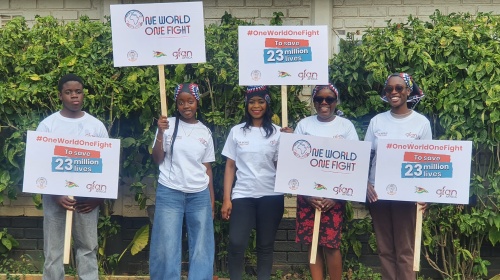
Loyce Maturu in maroon floral skirt poses for a photo with health advocates
By Michael Gwarisa
When Otilia Tasikasni learned she was HIV positive in 1991, she believed her life was over. The diagnosis then was not just a medical statement; it was a countdown. Doctors told her she had only two or three years to live, and every day felt like borrowed time.
“At one point, all I would think of was dying,” recalls the 59-year-old, her voice steady but her eyes betraying memories of that period. “Even though I was not sick then or showing any signs of illness, I was just waiting for my day to come… but the day never came.”
At the time, there was no antiretroviral therapy (ART) in Zimbabwe. For years, Otilia remained healthy, but in 2004 her condition worsened, and she was also diagnosed with tuberculosis (TB). She completed TB treatment before finally starting ARVs, a lifeline made possible through the Global Fund’s support to Zimbabwe’s HIV programme.
Today, Otilia has watched her children grow, seen her grandchildren born, and lived decades beyond the expiry date once stamped on her life.
In Bindura, Mashonaland Central, 33-year-old Loyce Maturu’s experience with HIV is different. Diagnosed at the age of 12 with both HIV and TB, she began treatment immediately, a privilege her elder never had. Her journey, however, began in loss. In 2000, she lost both her mother and younger brother to AIDS-related illnesses within the same week. Soon after, she fell seriously ill and was taken in by an aunt who ensured she received care.
Initially, her diagnosis was kept from her, but with the help of Global Fund-supported health workers, her aunt eventually disclosed the truth.
When I found out, I thought I would die just like my mom and brother,” she says. “I lost all confidence. I never thought I would finish school, have a family, or get a job. But thanks to the Global Fund, I accessed TB and HIV treatment, and today my life is full.”
Loyce is now married, a mother to two HIV-negative children, a university graduate, and holds a stable job. She says living with HIV is not without its challenges. “It is not easy taking medication every day, but I am committed to it because I know what is at stake for me and my children,” she says. “I am proud to say I am one of the 65 million lives saved by the Global Fund.”
From Otilia’s struggle in an era when HIV meant certain death to Loyce’s life shaped by early intervention and consistent treatment, their experiences underline a shared truth: access to ARVs transforms HIV from a death sentence into a manageable condition.
This progress is something the Ministry of Health and Child Care (MoHCC) says it is determined to safeguard. Early this year, many countries suffered setbacks in their HIV programmes following the cessation of United States government funding for the majority of HIV initiatives. Zimbabwe, however, has managed to maintain adequate drug stocks through the AIDS Levy and other contributions.
“We made orders using two companies to provide more ARVs. Those stocks are now in place to cover us up to the end of the year,” said Minister of Health and Child Care, Dr. Douglass Mombeshora. He added that while some batches had already landed in Zimbabwe, others were still being delivered, and steps were underway to procure additional stocks in advance to take the country through to the first half of 2026.
These stories and commitments are part of a nationwide transformation made possible by sustained investment in HIV prevention, treatment, and care. Behind every life saved is a network of health workers, community advocates, and international partners working together to sustain Zimbabwe’s HIV response.
It is this collective effort that the Global Fund Advocates Network (GFAN) seeks to protect. Across Africa, GFAN is uniting community voices and civil society organisations to ensure the Global Fund remains fully funded. The goal is to save 23 million more lives and prevent 400 million new HIV infections by 2029.
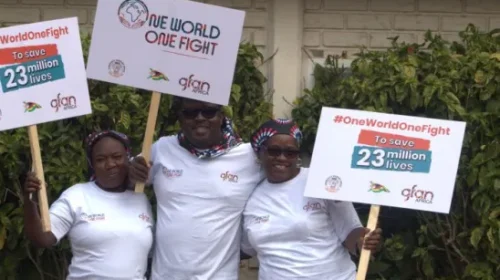
Mr. Itai Rusike, the GFAN focal person in Zimbabwe poses for a phot with Otilia Tasikani and Edinah Masiiwa a renowned health advocate and feminist
Mr. Itai Rusike, GFAN’s focal person, says the movement is rallying governments, philanthropies, and civil society to mobilise resources for the Fund’s 8th Replenishment. This, he explains, is essential to maintaining gains in HIV prevention and treatment so that no generation faces the uncertainty Otilia once knew.
“Sixty-four million lives have been saved since the year 2000 through the Global Fund’s support across the world. Now we are saying, as we move forward for the 8th replenishment, we are aiming to save at least 23 million lives,” said Mr. Rusike.
Formed in 2011, GFAN brings together voices from across the continent in support of a fully funded Global Fund to fight AIDS, Tuberculosis, and Malaria. Through its One World, One Fight campaign, members are using fabric art to highlight the Fund’s impact and remind the world that investing in lifesaving antiretroviral drugs is an investment in the greater good.
“You find that the majority of people who are on treatment are not paying anything. Yes, there are other out-of-pocket costs, such as diagnostic and transport costs, but at least you are guaranteed you are getting the medicine. However, we are saying all that could be lost in the blink of an eye if we do not have a fully funded Global Fund.”
Other European countries have already pledged towards the Global Fund 8th replenishment. Spain and Luxembourg came together at the Fourth International Conference on Financing for Development in Seville, Spain, to jointly announce increased commitments to the Global Fund’s Eighth Replenishment. Spain pledged €145 million, and Luxembourg pledged €13.8 million – both marking an increase over their respective commitments at the Global Fund’s Seventh Replenishment in 2022.
These contributions will support low- and middle-income countries to accelerate progress against AIDS, tuberculosis (TB) and malaria during the 2027-2029 implementation period. By enabling locally driven, lifesaving programs and reinforcing resilient and sustainable health systems, the increased funding will also strengthen global health security and preparedness for future threats.
In Zimbabwe, GFAN has been instrumental in mobilising political commitment from the highest office to maintain, and ideally increase, the government’s current US$1 million contribution to the Fund. The network also works to maximise the impact of health investments and advance the right to health by uniting community and civil society voices.
The Global Fund has significantly contributed to Zimbabwe’s ARV programme, investing in prevention, testing, and treatment services, including the procurement of ARVs for individuals living with HIV. Since 2009, the Global Fund has contributed over US$1.61 billion to the fight against HIV in the country and US$1.9 billion for all grants. UNDP is supporting the delivery of the Global Fund’s NFM 3 (2021–2023) of more than US$481 million in Zimbabwe.
CWGH Safeguarding Policy 2024
https://drive.google.com/file/d/1aumzUJOc0Gt4jfmkcyHpHu3cXyZlcRNk/view?usp=sharing
Afya na Haki Zimbabwe Partner Visit
Afya na Haki’s Zimbabwe Partner Visit – meeting Wlsazim and CWGH to deepen collaboration and ensuring the greatest possible impact on promoting reproductive justice within the legal framework. Turning our ideas into Action. @followers

WHA78 – TWO DAYS LEFT -The future of sustainable domestic financing for health in Africa is now!!!

A Worthwhile Opportunity #SRH

Afya na Haki (Ahaki) is an African research and training institute that uses africentric approaches to generate knowledge and enhance advocacy capacities in the areas of Health, Human Rights and Sexual and Reproductive Health and Rights (SRHR).
38 Measles Cases Reported in Zimbabwe
ZIMBABWE recorded at least 38 new suspected measles cases last week from all provinces except Bulawayo metropolitan.
The disease re-emerged several weeks ago and according to the Health and Child Care ministry, 15 suspected cases and zero deaths had been reported by April 3 this year.
The ministry said the cases were reported from Mashonaland East (6), Masvingo (2), Harare (2), Mashonaland Central (1), Mashonaland West (1), Matabeleland North (1), Matabeleland South (1) and one case in Manicaland.
The cumulative figures are 93 cases.
Experts who spoke to NewsDay expressed concern over the re-emergence of the medieval disease.
Johannes Marisa, a medical expert, said there was need for more awareness so that people knew how to prevent the disease.
“Measles has always been there and it can come in outbreaks which can be sporadic like what you highlighted above. What matters for now is for people to be cognisant of the fact that they have to receive a vaccination against measles, especially those that have not been vaccinated,” he said.
Marisa said children should be vaccinated at all costs to limit the risk of contracting the disease.
“Children should not escape vaccination. If one is not vaccinated, they are at a very high risk of mortality since the severity of the disease can be very high.
“I encourage everyone to take vaccination seriously so that we have a milder disease or we can stop the spread of the viral disease,” he said.
Marisa expressed concern over religious sects that do not embrace vaccination, saying this complicates healthcare delivery as it leaves people exposed to preventable diseases like measles.
Community Working Group on Health executive director Itai Rusike described the outbreak as unfortunate, adding it was sad that young Zimbabwean children, mostly those under the age of five, continued to contract measles despite the availability of a vaccine.
“The current measles outbreak in almost all the provinces may be as a result of a drop in vaccination coverage or depressed vaccination coverage post-COVID-19 and other health systems coverage.
“There is a need to accelerate immunisation activities to reduce measles cases and a deliberate effort should be made to reach out to the leadership of the various religious groups so that they can appreciate the benefits of getting their children vaccinated against measles,” he said.
Zimbabwe suffered a severe nationwide measles outbreak in April 2022 that proved to be deadly, particularly for children.
More than 750 children died from the disease within first six months of the outbreak.
Doctors fight silent war with mental health
By Nhau Mangirazi, Newsday

CWGH Executive Director Itai Rusike
DESPITE putting up a brave front while attending to patients, one of the few doctors assigned to a district hospital in rural Zimbabwe is unhappy.
Speaking in a hushed tone, he confesses that all is not well for the medical staff.
They normally face harsher realities of mental health challenges.
“The sad reality is that many doctors are undergoing mental health challenges fuelled by poor working conditions and lack of innovation and medical equipment to use,” he said, speaking on condition of anonymity.
“We are working under stressful conditions.”
Three medical doctors, instead of seven, man the hospital, making the workload unbearable for them.
According to a random survey, doctors have not been spared by mental health challenges which have become a growing concern, amid an economic crisis gripping the nation.
Key stakeholders have challenged government to invest more in the recruitment of medical personnel to ease the burden on the few who are working in the health sector, many of whom are considering migrating to stable economies.
The calls were made as the country commemorated the World Doctors Day on March 30.
Zimbabwe Association of Doctors for Human Rights executive director Calvin Fambirai confirmed that all is not well in the health sector.
“There is poor and limited recruitment, retention of skilled healthcare professionals,” he said.
“This can be achieved through improved working conditions and fair remuneration.”
Fambirai further explained that shortages of essential medicines and medical supplies have worsened the situation.
“Generally, doctors face shortages of personal protective equipment and it’s a battle for survival,” he said.
“We are committed to doing our best, but these limitations affect our operations.”
Community Working Group on Health executive director Itai Rusike acknowledged that in Zimbabwe, the standards have fallen really low, where doctors suffer burnout, low self-esteem due to the system-wide poverty, limited management support and lack of staff health support.
“While this mostly pertains to the public sector doctors, those in the private sector are also suffering from fatigue and sometimes late or non-payment of claims by medical aid companies, which take advantage of both the service providers and the patients,” Rusike said.
He, however, noted that by design, the work of a physician is mentally challenging as one is always expected to be in the know and to provide solutions, including support to junior staff.
“When no one cares for the carer, this becomes a tall order and results in mental breakdown. The family and other societal expectations also add rather than subtract from this burden,” Rusike said.
“Furthermore, doctors work as multi-professional and multi-disciplinary teams if they are to deliver comprehensive patient management.
“The current situation of a multi-systems collapse exerts undue pressure on clinical and public health physicians and their respective teams as they fail to provide optimal care and yet they too have numerous insufficiencies at personal level.”
According to Rusike, the work of a doctor comes as a package and gets severely disrupted should the tools of trade be unavailable.
“While medical doctors require a hospital environment to deliver effective services, the population health specialists require a conducive framework combining socio-economic, political and environmental provisions in order to function optimally and deliver the full basket of preventive, promotive, therapeutic and rehabilitative services.”
The World Health Organisation (WHO) said the commitment of doctors around the world was under silent crisis.
“Doctors worldwide face high levels of burnout, depression, anxiety and suicide. They dedicate their lives to healing others, yet their own mental health is often overlooked,” the global health body said in a statement on World Doctors Day.
It noted key facts affecting the doctors, including workload, low pay, unsafe environment and stigma that see many struggling in silence.
“WHO warns of a shortfall of 11 million health workers by 2030, where female doctors are 76% more likely to die by suicide than other women,” the statement said.
Globally, there are only 35% of countries that offer national work-related mental health support programmes.
“On this day, let’s raise awareness and celebrate doctors everywhere for the care and dedication they bring to their work everyday,” WHO concluded. -Newsday
‘Abuja Declaration target remains a pipe dream for Zimbabwe’
By Vanessa Gonye, Newsday
CWGH Executive Director, Itai Rusike
HARARE, Apr. 2, (NewsDayLive) – The Community Working Group on Health (CWGH) says Zimbabwe’s hope of achieving the Abuja Declaration target on healthcare funding will likely remain a pipe dream as allocations and fiscal disbursements to the health sector have remained below 15% of the national budget.
Signed on April 27, 2001 when African governments pledged to allocate at least 15% of their annual budgets to the health sector, the Abuja Declaration was meant to strengthen Africa’s health systems and ensure they are adequately capacitated to manage natural disasters.
Speaking on the country’s failure to meet the allocation as stipulated by the declaration on Tuesday, CWGH executive director Itai Rusike said despite progressive increases in budgetary allocations towards the 15% allocation for health, the fiscal disbursements have been inadequate to keep the system afloat.
“The 15% mark has never been attained, with government spending on health care as a percentage of total public expenditure increasing only from 10.6% in 2022 to 11.2% in 2023,” Rusike said.
“This poor financing for health has been another sore issue for the health workers as they interface with clients they cannot adequately serve.
“The majority of clients seen in the public sector remain without comprehensive healthcare except for a few selected diseases and conditions which receive vertical funding (HIV/Aids, TB, Malaria, maternal and child conditions).
“Despite the recent moves towards integration, community health workers get frustrated rendering inadequate service and have, therefore, been moving to more resourced jurisdictions.”
He said the situation means that universal access to health remains beyond reach, until the budgetary bottlenecks have been adequately addressed .
Rusike also noted that the past two decades have been characterised by massive outward migration of health, education, social and other professionals due to the protracted social, political and economic demise.
“This state of affairs has greatly impacted the government’s functionality with the high levels of corruption taking resources away from where they are needed most,” he said.
“The results have been telling in the multi system collapse including public health infrastructure and services.”
Health minister Douglas Mombeshora last month claimed that several key health indicators had shown notable improvements.
“We are particularly proud of the advancements in areas like maternal and child health, disease prevention, and healthcare infrastructure,” Mombeshora said.
“Looking ahead, we remain fully committed to our shared vision of increasing access to quality healthcare for all Zimbabweans.”
Revitalizing PHC4UHC by 2030 and rebuilding a fragile health system from the bottom up
… Addressing Zimbabwe’s Health System Demise and Brain Drain
By Itai Rusike
This article was first published in the Medicus Mundi Switzerland (MMS) Bulletin, #172 March 2025
The health and social services must function optimally for a country to realize social cohesion, economic growth, and be in tandem with the global health and security agenda. The current situation of investing in education and professional training and then “donating” the young and able-bodied products to already established, functional health systems located in wealthy countries is a luxury that poor economies like Zimbabwe cannot afford. The remaining few health workers remain frustrated and incapacitated to deliver effective care resulting in the subdued population health status currently obtaining in Zimbabwe.

CHWs in Zimbabwe participating at the National Health Financing Dialogue – @Itai Rusike
The development and transition of the health system in Zimbabwe over the decades
Zimbabwe has documented a number of transitions in its healthcare delivery system. In the pre-colonial era and before introduction of conventional medicine, traditional and spiritual methods of diagnosis and treatments were complemented by diets and taboos that supported the health across the life course. There were specific foods and medicinal plants for the pregnant women, newborns, young children, adolescents, young adults and the elderly. Various medicine men and women and the older uncles and aunts would oversee these, but there were no formally trained health professionals.
The colonial era came with introduction of western medicine but was limited mostly to the urban, mining and agricultural areas, and left the rural areas to continue their various traditional medical practices to address ailments. This saw the introduction of formal training of the natives in health especially nursing, environmental health to complement those introduced by the settlers. The first African Zimbabwean doctor was Samuel Parirenyatwa.
At its Independence in 1980, and just two years after the Alma Ata Declaration the government premised its health delivery system on the concept and philosophy of Primary Health Care (PHC) (WHO, UNICEF, 1978); greatly expanding the reach of conventional medicine to the rest of the country in terms of more health institutions and a defined healthcare workforce for the public health system, to be followed by a health workforce “establishment”. This was after the realization that the majority of the population resided in the rural areas and yet health care was centralized in the few urban centers. A number of policy pronouncements guided the process of ensuring the goal of “health for all by 2000”; including the white paper on health of 1981, “Planning for Equity in Health” of 1985, and the accompanying decentralization saw much improvement in the population access to affordable and quality health care.
In the 1997-2007 national health strategy, 85% of the population had access to a health facility within 10Km. The public health system catered for about 80% of the population through central government, local government, church and NGO run institutions. The life expectancy, maternal, child and general mortality in the population greatly reduced while health status and other favorable indicators improved leading to the country attaining notable health and welfare standards.
At its Independence in 1980, and just two years after the Alma Ata Declaration the government premised its health delivery system on the concept and philosophy of Primary Health Care (PHC).
Current situation
A number of challenges have almost reversed this progress and development of Zimbabwe’s health sector of which have been decades of socio-economic and political challenges that impacted negatively on health and related social services. These have been compounded by weaknesses within the system characterized by rigidity within the governance and management levels and resultant failures to adapt to the changes. The health workforce bear the brunt of these systemic weaknesses and failures and so after the demise of almost all the health system building blocks trained and experienced staff have been leaving in large numbers to join the private sector, neighboring countries and the diaspora. The major complaints have been poor remuneration, limited access to tools of the trade, as the health institutions continue to have stock outs of medicines and major supplies.
The weak governance systems also mean that there is no organized systems to adequately plan for and deploy the few trained personnel to benefit their populations, nor benefit the country when they emigrate to other countries.
The country and health system failed to adequately adopt to major transitions and have left healthcare workers with little or no support in terms of capacitation to cope, protection from infections within institutions and during public health crises, nor financial cover to make their work and contribution worthwhile. Among the transitions have been the structural adjustment programs, (ESAP) of the mid 1980’s, the HIV pandemic of the early 1990’s, and now the socioeconomic and political situation since the turn of the millennium. There have also been demographic, epidemiological and technological transitions in line with population increases, disease trends and this combination of major changes required a corresponding governance and management structure that responds with timely and effective policy and legislative responses that ensure sustainable service delivery with the health workforce at the center- being a services sector.
However the decentralization of early 1990’s was not followed by devolution and healthcare worker issues have continued to be centralized, fueling frustration and health worker exodus and thus almost emptying the institutions of their health workforce.
Despite progressive increases in budgetary allocations towards the 15% allocation for health, (Abuja, 2001), the fiscal disbursements have been inadequate to keep the system afloat. The 15% mark has never been attained, with Government spending on health care as a percentage of total public expenditure increasing only from 10.6% in 2022 to 11.2% in 2023.
This poor financing for health has been another sore issue for the health workers as they interface with clients they cannot adequately serve. The majority of clients seen in the public sector remain without comprehensive care except for a few selected diseases and conditions which receive vertical funding (HIV/Aids, TB, Malaria, maternal and child conditions). Despite the recent moves to integration Health Communitiy Workers (HCWs) get frustrated rendering inadequate service and have therefore been moving to more resourced jurisdictions.
This situation means that universal access to health remains beyond reach, until and unless the complex health situation is effectively addressed. The recent developments of wars, climate crises and the major shifts in the donor landscape well before the earlier warning of the 2030 deadline requires urgent action on the part of government and the health ministry.
The majority of clients seen in the public sector remain without comprehensive care except for a few selected diseases and conditions which receive vertical funding (HIV/Aids, TB, Malaria, maternal and child conditions).
Causes of the global health care workforce shortages
A number of factors are responsible for the current situation including the demographic and epidemic transitions. The inadequate health workforce in developed countries cannot cope with the combined complexities of chronic diseases compounded by ageing populations. Meanwhile in developing countries it’s the opposite in that the epidemiological transition has not been effectively addressed as they remain with a huge burden of infections, emerging and re-emerging diseases, unchecked chronic/noncommunicable diseases which include injuries, mental health conditions and substance abuse.
The demographics are characteristically young populations but with limited access to education and training opportunities due to weak health, education and other social systems. The weak governance systems also mean that there is no organized system to adequately plan for and deploy the few trained personnel to benefit their populations, nor benefit the country when they emigrate to other countries. The case in point being that of the expatriates deployed to Zimbabwe during the post-independence era and in recent times, the Cuban health, education etc brigades whose deployment is regulated by their state, and follows signed agreements with the receiving countries. The World Health Organization (WHO) Global code on recruitment of health care workers has not been heeded, neither is it enforceable in the member states as is the framework convention on tobacco control, (FCTC) and the international health regulations, (IHR, 2005, 20012), both of which are binding.
The current situation of investing in education and professional training and then “donating” the young and able-bodied products to already established, functional health systems located in wealthy countries is a luxury that poor economies like Zimbabwe cannot afford.
Social and economic consequences of a shortage of HCWs for countries with weaker health systems
In Zimbabwe, the past two decades have been characterized by massive outward migration of health, education, social and other professionals due to the protracted social political and economic demise. This state of affairs has greatly impacted on government’s functionality with the high levels of corruption taking resources away from where they are needed most. The results have been telling in the multi system collapse including public health infrastructure and services.
As a result, the major determinants of health have become severely neglected, causing outbreaks and adding a considerable burden of preventable diseases and conditions. For a largely unemployed population, the paradox is the huge out of pocket expenditure for preventable ailments while the collapsed system cannot serve the clients. The result has been adverse health indicators across the population with considerable premature, avoidable and excess mortality.
How do HCWs experience the effects of staff shortage?
Healthcare workers are supposed to work as teams and seldom in isolation. At central, city and provincial hospitals there used to be multidisciplinary teams of 2-4 consultants per firm, with registrars, senior and junior residents, then the nursing team, physiotherapists, nutritionist etc., but currently there may just be one doctor -and few nurses. The workload becomes unmanageable and each shift is taxing as oftentimes one cadre has to carry out the tasks of 3 or 4 others, with no one to discuss the patient condition, treatment options nor debrief.
This has resulted in burnout of the few cadres whose recognition and remuneration has not increased significantly despite the increased demand on them. The patients and their relatives often accuse them of blocking services and pilfering medicines and supplies for their benefit when in fact it’s the nationwide corruption that has stripped the system and caused the neglect. At the districts and remote clinics often one nurse has to oversee a whole unit and this compromises patient care, accurate documentation and patient follow up. There is little time for continuous professional development as most of the time the staff is overwhelmed and working solo.
The patients and their relatives often accuse them of blocking services and pilfering medicines and supplies for their benefit when in fact it’s the nationwide corruption that has stripped the system and caused the neglect.
How effective is the WHO Global Code of Practice on international recruitment of HCWs?
For countries like Zimbabwe the global and even the WHO Afro regional office pronouncements on preventing or minimizing health worker migration have been ineffective. There has to be some acknowledgment to the sending country to compensate for its investment in the professional and this to be ring-fenced to further enable training and or improving the working environment of those who remain in-country. Deliberate efforts must be made to invest in addressing the demise of the health systems that have bled too many healthcare workers by the major receiving and wealthy nations.
There has to be some acknowledgment to the sending country to compensate for its investment in the professional and this to be ring-fenced to further enable training and or improving the working environment of those who remain in-country.
What are the potential solutions to address HCWs crisis/shortage long term?
– Address the work environment by re-investing and revitalizing the health delivery system across the WHO’s six building blocks of a health delivery system, and in tandem with a revitalized primary health care for universal health access (PHC4UHC, CWGH, PHCPI, 2022).
– Implement the health financing reform in line with the dwindling donor support and the critical need for a robust local financing architecture.
– Improve the governance and management of the healthcare workforce and ensure that well trained health professionals are in charge and make decisions rather than the corruptly appointed management.
The latter have been competing with and further frustrating the healthcare workers and yet remain without a sound understanding of the system and its complexities. Given the extent of the demise and the high turnover of staff over a protracted period, there may be need to bring in some of the old guard, (retired but not tired) to hand hold and mentor the young inexperienced staff. This can help restore the dignity of the profession, improve confidence, service delivery and patient outcomes.
The government must also ensure implementation of the Constitutional provisions for health and its determinants, enforce the public health act and enforce mandates across all sectors that hold key determinants of health in order to effectively prevent disease and promote health. The result will be more manageable workloads for the reduced staff. Furthermore, there has to be strategies that address the huge and unchecked burden of non-communicable diseases, injuries and mass trauma casualties, mental health, substance abuse and climate induced health issues that have not yet received attention but are over-loading the limited health workforce.
Itai Rusike is the Executive Director, Community Working Group on Health (CWGH) – Zimbabwe. Itai is a Public Health Activist with more than 20 years’ experience organising involvement of communities in health actions in Zimbabwe. He is a member and chairperson of various health related committees, along with being the Vice-President of Medicus Mundi International Network.
For the full bulletin, follow link : https://www.medicusmundi.ch/en/advocacy/publications/mms-bulletin/health-workforce-shortage-are-there-potential/kapitel-1/addressing-zimbabwe%E2%80%99s-health-system-demise