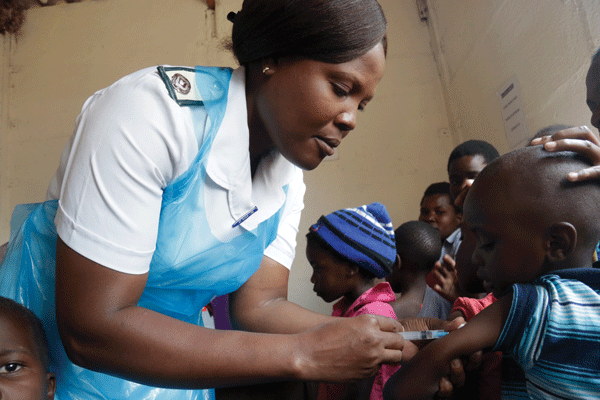
Poor adherence to ART on rise

THE country’s fight against HIV is facing new challenges due to reports of misuse and mismanagement of anti-retroviral therapy as reflected by the ballooning cases of second-line treatment countrywide.The National Aids Council (NAC) 2015 report reveals that people on second line treatment are 15 337, an increase from the 13 036 recorded in 2014.Poor adherence to ART has been shown to be a major determinant of disease progression, mortality and health care costs.
While high adherence levels can be achieved in both resource-rich and resource-limited settings following initiation of ART, long-term adherence remains a challenge regardless of available resources.
Some people living with HIV stop taking their medication due to a number of reasons, among them fear of disclosure, stigma and discrimination whilst others listen to prophets who claim to cure the virus.
NAC communications director, Ms Medelina Dube, said non-disclosure to children living with HIV was also fuelling treatment failure.
“Defaulting is particularly rampant amongst young people born with HIV. This is because most parents or guardians do not tell them why they have to take medicines every day and they don’t even know they are living positively,” Ms Dube explained.
“Some are told that they have to take medicines because they have heart or kidney ailments. So when they don’t feel sick they don’t take medicines, thereby defaulting.”
Zimbabwe National Network of People Living with HIV (ZNNP+) executive director, Mr Dagobert Mureriwa, concurs that treatment failure is expensive.
“As a country, we have failed to put in place robust adherence and counselling services to monitor treatment failure. It’s cheaper for a country to have people in one treatment line,” he said.
“Yes, people respond to ARVs differently but due to the fact that 80 percent of our health sector is donor-funded, it becomes unsustainable to have treatment failures.”
Treatment failure is detected when one goes for viral load testing and is found to have more than 1 000 copies per mil. A decreasing CD4 count is also a sign of treatment failure as well as deterioration of one’s health.
Mashonaland East recorded 1 377 cases of second line ART patients, Mashonaland Central 477, Matabeleland North 455, Masvingo 1 448, Harare 3 684, Matabeleland South 645, Mashonaland West 1 430, Manicaland 2 155, Bulawayo 2 187 and Midlands 1 479.
People taking anti-retroviral drugs have been urged to adhere to their treatment requirements so that they do not develop resistance thereby incurring huge health care costs.
The director of the Aids and TB unit in the Ministry of Health and Child Care, Dr Owen Mugurungi, said HIV treatment success is hinged on sticking to specific times of taking the ARVs and on a daily basis without fail.
“Adherence is critical in suppressing the virus and the level of drug concentration should be maintained so that treatment becomes effective,” said Dr Mugurungi.
“If one defaults on treatment for whatever reason, the virus mutates and becomes resistant to drugs being taken. It then becomes expensive to move a patient from the first line of treatment to the second line.”
Currently in Zimbabwe most people are still on the first line of treatment, which is way cheaper and readily available in most public institutions.
Zimbabwe introduced ARV therapy in 2004. The country adopted the WHO treatment guidelines recommending patients begin treatment at a CD4 count of 500, compared to the 350 count in earlier treatment guidelines.
Pregnant women and infants living with HIV are being initiated on treatment regardless of their CD4 count. As such, trends show an increase of people living with HIV.
The number has risen to 1 412 790 in 2015 from 1 356 010 in 2011.
Regimens used for second line treatment include either a combination of tenofovir, lamuvidine, atazanavir/ritonavir or zidovudine, lamuvidine, atazanavir/ritonavir or abavacir, lamuvidine, atazanavir/ritonavir.
NAC used $9,7 million to procure tenofovir, lamivudine and efavirenz and $2 475 970 to buy atazanavir/ritonavir in 2015.
Treatment failures are attributed to lack of drug adherence and drug resistance.
“The treatment gap is being widened because second line treatment is more expensive than the first line. It is more desirable to have as few people on second line as possible,” added Ms Dube.
“NAC through its advocacy programmes has been reaching out to people across Zimbabwe, encouraging them to adhere to treatment. People are encouraged to take their medicines correctly and consistently as prescribed by health personnel.
“People are also encouraged to start treatment early before they fall sick. This means people should get tested for HIV as frequently as possible.”
The University of Zimbabwe Clinical Research Centre (UZCRC) had eight patients on third line ARVs as of September 2012 with an anticipation of not more than 100 people on third line in the country.
An increasing number of patients will eventually need third line medicines which are used when patients stop responding to first and second line treatment regimens.
A medical practitioner who agreed to speak on condition of anonymity said HIV treatment is a sad trend.
“Though it may seem like a small number to some but the fact is it is increasing and the country needs to be prepared to tackle the problem head-on,” said the medical practitioner.
“For those failing on second line the options are severely limited requiring rigorous trials by the health practitioner to determine which of the remaining drugs can be used.”
Third line ARVs include darunavir, raltegavir, etravirine and ritonavir.
Community Working Group on Health (CWGH) director, Mr Itai Rusike, said the ballooning cases of second line treatment could further widen the treatment gap.
“Second line treatment is expensive and the possibility of having a sizeable number on third line is condemning those in need of such treatment to death because they may never access treatment after this,” he said.
However, third line drugs are either unaffordable or unavailable in many developing countries.
“Drug resistance may spread to other related drugs thus limiting future treatment options,” added Dr Mugurungi.

SUNDAY MAIL REPORTER SEPTEMBER 18, 2016 Shamiso Yikoniko

Eradicating Aids through self-testing

Eradicating Aids through self-testing

Vivian Mugarisi recently in Durban, South Africa

As the world gear up the response to HIV/Aids, self-testing appears to be of great importance in achieving the 90-90-90- target. The 90-90-90 is an ambitious target to help eradicate Aids. But other long standing barriers to accessing comprehensive HIV testing remain significant, especially in Africa.There are still people who worry about HIV-related stigma, those who do not see the need to know their status for one reason or the other and those who are afraid of dying of Aids-related diseases so they would rather not know.

While self-testing could actually be the key for the Zimbabwe to achieve the first 90, which seeks to ensure that all persons living with HIV know their status, lack of linkage to care, counselling and the ability of individuals to test themselves accurately and interpret results remain a major challenge in the successful implementation of home service testing.

But the introduction of this HIV self-service looks imminent.

In an interview on the side lines of the 21st International AIDS Conference in Durban, Aids and TB Unit director Dr Owen Mugurungi said the pilot project which was demonstrated in Mazowe in March was a way of evidence gathering to present to the World Health Organisation for guidance.

He said for the country to secure funding for the project from various donors, there should be guidelines on how to carry out self-testing.

“The unfortunate thing is that when countries that have resource constraints like Zimbabwe go to our partners and ask for some money for self-testing, they will then say there is no guidance for it.

“So what we are doing now is to get evidence for WHO to be able to give normative guidance so if the evidence is good WHO would then come up with guidelines then we can go back to our partners and say give us money for self-test,” he said.

Dr Mugurungi said the country will embark on the programme despite resource challenges in preparation for a full-blown project once resources are secured.

“We, however, feel that with our own limited resources, we should not let the idea or capacity or ability to self-test fade before WHO give us guidance or before donors give us money to do that,” added Dr Mugurungi.

Mr Itai Rusike, the director of the Community Working Group on Health, said information on HIV should be availed such that individuals understand what it means to be positive. He also said there was need to ensure that disclosure issues are addressed and counselling is offered right up to the family level. “I think it is helpful as long as the community understand what it is doing,” he said.

“My worry is the event that someone conducts the test, fails to interpret the results and is nowhere near a clinic for psycho-social support, they may commit suicide.

“Counselling services should then be available at all levels, disclosure issues need to be addressed and we also need to consider gender issues, action after tests, stigma in community, the accuracy of tests, availability of confirmatory tests and so on,” said Mr Rusike.

Gutu South legislator, who is a member of the Parliamentary Portfolio Committee on Health, Dr Paul Chimedza said the country has been ready for a long time and more people now have the knowledge on HIV/Aids related issues compared to decades ago.

“I think Zimbabwe has been ready for a long time it’s just that we have been hesitating to move into this, we need people to have access to testing themselves.

“I know people talk about committing suicide and this and that but we have had diseases that are worse than HIV. “We have had cancers that can kill with no cure but people have been told they have cancer but they survived,” he said.

Dr Chimedza also said self-testing is one way to close the testing gap as nearly 45 percent of the people who should know their status are still in the dark.

Despite the loopholes that need urgent addressing before rolling out home-testing programmes, manufacturers of the rapid self-test kits said it was high time developing countries embrace the low- cost kits to meet the 2020 target.

Premier Medical Corporation Limited president Nilesh Mehta said developing countries can start using these kits as they are very affordable compared to previous testing methods, among them the oral self-testing approach.

“We understand that some of the African countries cannot afford expensive test kits so we produce the highest quality product at a low price,” Mr Mehta said.

One self-testing kit is going for 75 cents which is four times lower than the oral test which costs at least $3 per kit.

The high temperature stable test kits comes with everything one would need to do the test and the product has already been used in South Africa, Ethiopia and Ghana; with South Africa getting at least 40 million kits a year.

Diagnostic Laboratory Suppliers managing director Mr Edgar Chandiwana said various stakeholders should come together to support Government in ensuring that links to counselling are put in place for comprehensive approach to offering HIV testing, treatment and support.

He said telecommunication companies must provide toll free numbers for the public to connect with health care providers at any given time.

“It’s in our best interest to move towards the 90-90-90 and it can only be possible if we can get to have more people knowing their status,” said Mr Chandiwana.

Added Mr Chandiwana: “Though issues of counselling are paramount, we need to keep on moving.

“In our current situation in Zimbabwe, it is an issue that the ministry is looking at closely and with the current infrastructure, someone should be able to call, toll free, and information should be readily available in pharmacies and supermarkets.”

“We need mobile communication companies to come on board to make this a success as they could help bridge the gap of the missing link to counselling services through toll free services,” he said.

He argued that while developing countries are lagging behind in terms of technology, there is need to take a bold move and roll out self-test to achieve the UNAIDS target to end Aids by 2030.

According to the World Health Organisation, self-testing is not new as it is already in use in Australia, France, Britain and the United States.

Call for health sector funding review

Call for health sector funding review

HEALTH and Child Care Minister David Parirenyatwa has called for treasury to increase funding of the health care system as shortages of resources are compromising service delivery and affecting the health care quality.

The statement comes at a time when Harare’s biggest referral hospital, Harare Central Hospital, is facing an acute drug shortage that has forced it to suspend elective surgeries.

“We need to be able to finance our health system. We cannot be judged as a nation that cannot put money into our health care system.

“Inadequate government funds have negatively affected health service delivery. A country is judged by how it looks after the health of its people,” said Minister Parirenyatwa.

Minister Parirenyatwa who has been touring the country’s health institutions to appreciate the challenges faced by the hospitals recently reiterated that the country’s hospitals were facing a myriad of challenges due to underfunding citing the shortage of drugs as the major challenge.

He said the country’s hospitals were facing shortage of drugs, health personnel, equipment and inadequate infrastructure following an assessment of the country’s major hospitals.

The Community Working Group on Health has also reiterated that the Government should consider increasing health funding in its 2017 budget.

The lobby group director, Itai Rusike called the Government to move beyond tokenism and increase its commitment to funding services that are currently being funded by donors.

“Government has continued to collaborate with its external partners for the funding and sustenance of selected programmes with external funding being channelled off-budget to reduce fiduciary risks.

“However, external funding has somehow become fungible and has in most cases replaced government funding instead of complementing it,” argued Rusike.

“We are also concerned with the high level of donor dependency on medicines and maternal health programmes. Medicines requirements and RMNCH programmes remain some of the most externally dependent programmes exposing them to arbitrary cuts and funding withdrawals.”

Rusike said this donor dependency and not prioritising health funding had plunged Harare central hospital into a crisis that has forced it to suspend elective surgeries due to an acute shortage of drugs which has seen the hospital even running out of basic pain killers.

As the hospital’s crisis worsens, chronically ill patients who get their monthly supplies from this hospital have not been spared.

The health sector has over the years relied on donor funding with over 90 percent of medicines coming from donors, a situation that has mostly affected the poor who mainly rely on these public health institutions.

CWGH wins Africa NGO Leadership Award

CWGH wins Africa NGO Leadership Award - Press Statement

Mr. Rusike holding the CWGH Leadership award

The Community Working Group on Health (CWGH), Zimbabwe’s leading health advocacy group, was conferred with this year’s glamorous Africa NGO Leadership Award for its outstanding achievements in the health sector at the 6th Edition of the Africa Leadership Award held at Le Meridian Hotel in Mauritius last week. The award, which is given to those that make a difference to the lives of others, was received by CWGH Executive Director, Mr Itai Rusike.

The CWGH, which was established in 1998, was recognised for leading and giving visibility to community processes in health in Zimbabwe. Over the years, the organisation has positioned itself as a voice in the health sector and built community power, organizing involvement of communities in health actions within their communities and around Primary Health Care (PHC). It has also empowered communities through health literacy to meaningfully participate and contribute towards health governance, environmental health, and mobilizing resources to support health centres. This is being done through community level initiatives with limited external support.
The Africa Leadership Awards are presented by the World CSR and the STARS OF THE INDUSTRY GROUP. The event, which was attended by about 150 senior leaders and decision makers, recognise the achievements made by selected high profile corporate business in Africa and honour their contributions towards their countries’ economic development.

The Jury decided to honour Community Working Group on Health (CWGH) with the Africa NGO Leadership Award. The award is conferred on "Outstanding professionals who have the vision, flair, acumen and professionalism to demonstrate excellent Leadership and Management skills in an organisation, making changes and achieving results.

Criteria: Those who can make a difference to the lives of others are chosen. For the quality of their work, global reach and outlook and ability to contribute value of social change. Change can be quantified - especially since it impacts the lives of many. If it does then it is positive change. But the main is Making A Difference (MAD).

Process: The NGO Leadership Award is intensely researched process undertaken by the research cell which consists of Post Graduates in History & Management with over 5 years research experience posts their studies. It is the iconic job of the research cell to produce a shortlist of Individuals who are doing extraordinary work and track the record of their achievements. The shortlist is then reviewed by a Jury comprising of senior professionals from across the globe.

The Community Working Group on Health (CWGH) is a network of national membership based civil society and community based organisations who aim to collectively enhance community participation in health in Zimbabwe.

For further information, please contact:

The Executive Director
Itai Rusike (Mr)
Community Working Group on Health (CWGH)
312 Samora Machel Avenue
Eastlea, Harare
Zimbabwe

Tel: +263-4-498 692 / 498 983 / 498 926
Cell: +263 772 363 991
Email: Itai@cwgh.co.zw / cwgh@mweb.co.zw
Website: www.cwgh.co.zw
Twitter: @itairusike
Facebook.com/CWGH/

CWGH National Annual Meeting and AGM

CWGH 23rd National Annual Meeting and AGM

CWGH 23rd National Annual Meeting and AGM

The Community Working Group on Health (CWGH) is holding its 23rd National Annual Meeting and Annual General Meeting (AGM) on the 16th and 17th of November 2016 respectively at the Rainbow Towers Hotel in Harare. The meeting will run under the theme "Leaving no one behind in National Health: What should Zimbabwe's contribution be?"

The CWGH will use the opportunity to review national health issues of concern and propose strategies for enhancing the health sector and in particular community participation in health. The CWGH is a strong advocate of primary health care and preventative health, and strengthening district health systems.

CWGH nominated to influential national health committees

CWGH nominated to influential national health committees

The Ministry of Health and Child Care (MoHCC) has nominated the CWGH to the National Maternal Deaths Surveillance and Response (MDSR) committee and the National Reproductive Maternal Neonatal Child and Adolescent Health (RMNCH-A) following the organisation’s sterling work in improving maternal and child health in Zimbabwe.

Some of the functions of the MDSR committee include reviewing maternal deaths reported in the last quarter as captured by the MDSR system and HMIS with the aim of assessing timely identification, notification/reporting, review and response as well as making focused, geography and stakeholder specific and actionable recommendations that are linked with avoidable factors based on the analysis of maternal deaths in the past quarter.

The purpose of the RMNCH-A committee is to oversee and coordinate the national RMNCH-A programme with the aim of bringing efficiency, complemmentarity and effectiveness in programme management, implementation and monitoring.

Increase funding to health for attainment of Universal Health Coverage

Increase funding to health for attainment of Universal Health Coverage

Government must allocate more funding to the health sector in the 2017 National Budget to ensure that the country achieves universal health coverage (UHC) that continues to elude the majority of Zimbabweans.
For years, inadequate funding for health care has meant that the country has been unable to realise its full potential for providing sufficient and quality services to people. With increased funding to health, Zimbabwe would be able to deal with the current disease burden, address human resources shortages, access to medicines and build more facilities to reduce the distance patients travel to seek health services.
The country needs to progressively move towards meeting the Abuja target of not only allocating 15 percent of the National Budget to health, but actually spending that allocated amount on the sector. It has been noted that in the past years, the Government would allocate funds to health, but would disburse much less to the sector to make any meaningful impact.
Fifteen years after African governments committed themselves to the Abuja Declaration in 2001, only six countries have been able to meet the target. These are Liberia, Madagascar, Malawi, Rwanda Togo and Zambia.
Rwanda, which was involved in a devastating civil war for several years, already spends at least 23,7 percent of its national budget on health care, a percentage that is three times more than what Zimbabwe allocated to healthcare in 2015.
Presently the Zimbabwe Government, which relies heavily on donor funding, has cited a shrinking fiscal space for failing to meet the Abuja target. It is therefore advisable for the country to seek innovative domestic ways of funding the health sector as relying on foreign funds is a national security risk should the donors withdraw support for any reason.
With a narrow revenue generation base, the Government must consider the introduction of “sin taxes” on commodities such as tobacco and alcohol not only as measure of raising funds, but a way of reducing the consumption of harmful products.
It should be emphasised that reaching Sustainable Development Goals (SDGs) requires a sustained momentum in funding the country’s health care system. The current resources nexus shows that the tertiary and central level health facilities attract more funding than the lower levels as a result of the intensity of their services.
While there has been some improvement in Maternal, Neonatal and Child Health (MNCH) indicators, infant, U5s and maternal rates remain a cause of concern as the current rates are too high compared to regional rates. The Government is far from achieving its target of 326 deaths per 100 000 live births by 2020 although maternal mortality declined from 960 live births in 2010 to 651 in 2015.
It should also be noted that poorer households continue to endure disproportionate losses in infant, child and mortality as compared to the richer households so more funding should go towards primary level care.
The current ratio of over 70 percent funding for curative services and less than 10 percent funding for preventive services will not see the country moving towards reducing further the rates of maternal and child mortality.
Lower levels of care handle more patients than the tertiary and central level facilities and it is therefore prudent that a significantly larger share of the budget should go to the district level. The idea of building district hospitals in areas such as Harare, Bulawayo, Wedza and other parts of the country to alleviate the burden of patients at the central level remains a critical requirement. This must be supported by increasing or reviving health grants to urban councils to lower their user fee charges to more affordable levels.
A huge number of patients in the country are still enduring unbearable long distances to access primary health care facilities. The Government therefore needs to increase funding for outreach services so that communities in remote areas and newly resettled areas can also have access to care.
It is also important to resuscitate community support structures such as ward health teams and ward development committees as well as remunerating community health workers well especially village health workers.
There is evidence which shows that socio-economic and geographic inequalities and inequities are hampering access to health services especially for non-communicable diseases (NCDs) such as cancer services.
The State should come up with a clear position on treatment of NCDs. It is important that the State decentralises services and subsidises their treatment costs to lessen the burden on the poor who are the majority.
The creation of a national health insurance (NHI), a process which started in 1991, remains a noble idea but it would be more appropriate if the management of this body is given to the National Aids Council (NAC) given their experience in managing the Aids Levy.
However, there is still need for more inclusive consultations with stakeholders to come up with a comprehensive Bill. Health insurance is currently dominated by a well-established but poorly regulated private sector, serving only 10 percent of the country’s population and is under threat due to increased job losses.
The cost of blood products has become expensive and inaccessible to many. A bottleneck analysis that was carried out by the MoHCC shows that 60 percent of secondary facilities were found to have no blood in their stocks.
Some facilities could not stock blood because of unavailability of fridges, electricity and general poor infrastructure. There is therefore need for the Government to consider other alternatives such as solar refrigerators for storing blood products.
Surveys on human resources and infrastructure have identified huge gaps in terms of human resources and health care technology availability. There is therefore a need to move towards ensuring that agreed normal levels and types of human resources are available and financed at the district level as well as ensure that the minimum healthcare technology is found at the district level.
For example, only 47 percent of facilities in the whole country have TB diagnostic testing equipment while 44 percent of facilities have functional glucometers and strips for diabetes testing and screening.
It is also important to review the staff establishment to reflect the current environment. Zimbabwe is still using a staff establishment of 1983 when the country’s population was 7.5 million but that has since doubled and the disease burden has also increased.
Therefore, there is urgent need to review the staff establishment in order to reduce work overload and burnout health workers.
With the current staffing scenario, the Ministry of Health and Child Care must be exempted from the proposed staff rationalisation which is being spearheaded by the Ministry of Finance and Economic Development to reduce the Government’s unsustainable wage bill.
The health ministry is understaffed and desperately needing to fill in critical staff posts for it to enable to provide basic health care services. For example, 23 percent of all provincial and central hospitals do not have a dentist, most district hospitals do not have four doctors as required in the current establishment system while some are manned by pharmacy technicians instead of degreed pharmacists.
Itai Rusike is the Executive Director of Community Working Group on Health.

September 27, 2016 Features, Opinion & Analysis
Itai Rusike Correspondent

Health experts warn over SDG targets achievement failure

Health experts warn over SDG targets achievement failure

September 26, 2016

HEALTH experts have warned that Zimbabwe might fail to achieve its health sustainable development goal (SDG) targets as long as funding for the health sector remains below 15% of the national budget.

by VENERANDA LANGA

Itai Rusike, executive director of Community Working Group on Health (CWGH), said there was need to increase the health sector budget next year to deal with the disease burden, access to health facilities by all, address health sector human resource challenges, and deal with the issue of access to medicines by all.
In the 2016 National Budget, Finance minister Patrick Chinamasa allocated only $370,79 million to the Ministry of Health and Child Care, representing 8,3% of the total budget, a far cry from the 15% allocation recommended by the Abuja Declaration on Health.
“Given the current fiscal constraints, government should prioritise and focus on cost-effective health programmes and interventions,” Rusike said.
“Reaching the SDG targets requires a sustained momentum in financing our health care systems, and while progress has been made in improving our health indicators, there is need to sustain the momentum in funding of health care systems.”
Employment costs in the Health ministry were said to be consuming the bulk of its budgetary allocation, leaving little funds for operational costs and capital projects. The result was said to be over-reliance on donors to fund different health programmes such as HIV and Aids, maternal and child health.
“External funding has, somehow, become fungible and has, in most cases, replaced government funding instead of complementing it,” Rusike said.
According to a Unicef 2016 health and child care budget brief, off budget support to the Health ministry by development partners was projected to be approximately $400m, an amount which even exceeded government’s national budget allocation to health.
Most of the donor dependence in the health sector was said to be on medicines.
CWGH expressed disappointment over maladministration at some hospitals, where, in the past, the Auditor-General’s reports indicated expiry of medicines at some health centres, while some hospitals experienced shortages.
“NatPharm should be capacitated so that it can be able to provide regular, affordable and timely supply of essential drugs.”
CWGH also suggested medicinal support should be extended to the elderly and vulnerable groups suffering from chronic illnesses such as diabetes and hypertension as they cannot afford buying medicines that were usually available only at pharmacies.

Myriad of problems compound Harare Central Hospital’s woes

OPPOSITION parties and health stakeholders have reacted angrily to the deteriorating standards of healthcare in the country, with some calling for a complete overhaul of the entire ministry presiding over the decay.

BY PHYLLIS MBANJE
a-nurse-seen-vaccinating-a-child-to-prevent-rubella-measles

Harare Central Hospital relies on on revenue from paying patients, but 40% of patients constitute the elderly and toddlers who are treated for free

The health crisis in Zimbabwe is deepening and taking on a frightening plunge, with shocking reports that the country’s largest referral hospital, Harare Central, has run out of critical and basic drugs.

So serious is the situation that last weekend, the hospital had to shut down most surgeries except in cases of emergency and those involving maternal cases.


But this is not the first time that the hospital, built in 1941 and catering for more than 1 500 deliveries and handling 6 000 causalities per month, has raised the red flag.

The hospital is now struggling to offer quality services. The leaking roofs, peeling floors and cracked walls that become a breeding ground of agents that cause infections, are exposing hundreds of patients to more diseases.

This week, there was outrage over the suspension of surgeries at the hospital, which handles over 60% of all referrals countrywide.

Harare Central Hospital, which is literally falling to pieces with massive leakages from pipes within the walls, is in a dire position.

“This (suspension) is a symptom of a Zanu PF government that is overstretched, unaccountable and overwhelmingly failing the suffering citizens of Zimbabwe,” MDC spokesperson, Kurauone Chihwayi said.

The party further emphasised that the suspension of surgeries at the hospital, due to lack of drugs, is a reflection of the sorry state of public hospitals countrywide and a glaring consequence of the misplaced priorities of government.

“We view this latest disaster as a death sentence to citizens desperately in need of medical attention, who unlike the First Family and Zanu PF chefs, cannot afford the privilege of seeking treatment in Singapore, India, South Africa or private hospitals locally,” Chihwayi said.

MDC accused the government of sustaining “President Robert Mugabe’s merry-go-round trips around the world, which gobble up millions of dollars” while the health sector literally shuts down.

“It is clear that government’s only concern now is Mugabe’s happiness and not the well-being of its suffering millions,” Chihwayi said.

The People’s Democratic Party (PDP) secretary for health and child welfare, Sibongile Mgijima, said the deplorable state of public healthcare in Zimbabwe shows how the government has abandoned its priorities.

“Public healthcare is now in the intensive care unit due to serious shortages of basic medical services and medicine such as aspirin and antibiotics,” she said.

Two years ago, during a tour of the hospital, Harare Hospital’s chief executive officer, Peggy Zvavamwe admitted that the situation was dire, with quotations to repair a single ward requiring over $30 000.

“Our financial situation is dire and if we do not get relief soon, the quality of services will be compromised,” she said.

The hospital’s clinical director, George Vera, who was part of the tour, however, said their precarious situation was compounded by the fact that 40% of their patients were those over 65 years and the under-fives, who do not pay for services rendered.

Since then, nothing much has changed and the situation is now critical.

“We rely mostly on revenue from paying patients, but our situation is that 40% constitute the elderly and the under-five, whom we treat for free,” he said. “The referral system does not exist, we now receive people from everywhere and these are coming to die here.”

Health and Child Care minister David Parirenyatwa recently urged Zimbabwe to swallow its pride, in the face of dwindling resources for the public health delivery system and engage donors, among them the United States, in order to mobilise funds for the sector.

Parirenyatwa said, although the government had reversed the near collapse of public health delivery system, the country had not yet met its set goals and targets.

Community Working Group on Health (CWGH) director, Itai Rusike said, for poor Zimbabweans, public health investments have an impact in reducing household spending through provision of accessible, equitable and affordable disease prevention, health care and consequent reduction in losses of time and costs of consumption due to ill health.

“There is need to progressively move towards meeting the Abuja target of not only allocating 15% of the national budget to health, but actual spending of 15% of all government expenditures,” he said.

In a position paper on budget allocations for the health sector, CWGH said domestic funding remained skewed towards employment costs leaving little funds for operations costs, and capital programmes.

“As a solution, there should be a shift to performance based financing and needs based budgeting system, which will likely result in the narrowing of the gaps between the have and the have-nots,” Rusike said.

Close to 90% of hospitals and clinics in the country are operating without essential medicines in stock, while 80% of the posts for midwives remain vacant in the public sector, and over 3 000 nurses do not have jobs.